Collaborating for financial well‑being.
Human-centred financial resilience training, certification, and partnership pathways for organizations and communities — from The Trauma of Money™ Institute.
“Not what’s wrong with your clients — but what happened to them, what they inherited, and how they’ve adapted around money.”
Reshaping how we understand money, power, and value.
The Trauma of Money™ (TOM) Institute of Education and Research offers an internationally recognized certification program that has trained thousands of professionals across more than 28 countries. The TOM Method situates people within a broader collective context — including societal and systemic trauma — rather than focusing on “fixing” the individual.
This approach provides frameworks for healing both individual and collective wounds, laying the foundation for financial agency and well-being. The Institute also offers professional training through private workshops, organizational partnerships, and an online education series.
Building on this work, TOM has developed a new certification for financial professionals — the Human-Centred Financial Method™ — designed for advisors and wealth professionals navigating the Great Wealth Transfer and an AI-driven financial world.
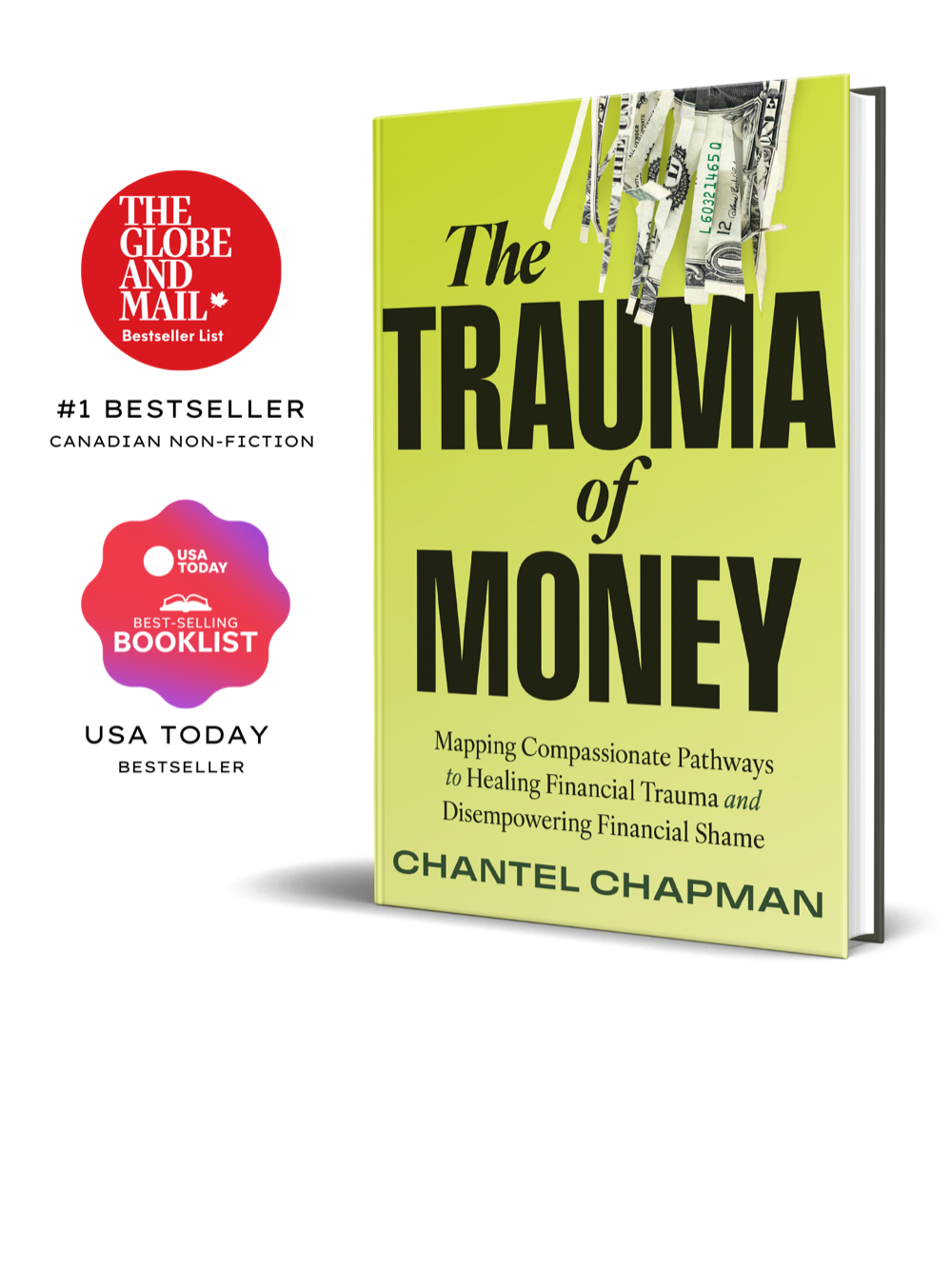
The Trauma of Money
by Chantel Chapman
Mapping Compassionate Pathways to Healing Financial Trauma and Disempowering Financial Shame. A comprehensive exploration of how trauma — generational, relational, societal, or systemic — shapes our financial behaviours, and introducing the six-phase Trauma of Money Method™ to decrease financial shame and reclaim agency.
Four pathways to bring human-centred finance into your organization.
From individual certification to bespoke organizational training, workshops, and program-design consulting — each pathway is shaped to your team’s context and goals.
TOM™ Professional Certification — Open Cohort
An 18-week online certification in the Trauma of Money™ Method, open to individual professionals across sectors. Send a team into the open cohort and learn alongside practitioners from finance, mental health, philanthropy, and community work.
See Tuition & Tiers →Professional Certification — Organizational Pathway
A bespoke, organization-specific certification — your team can be certified in either the TOM™ Professional Certification or the Human-Centred Financial Method™. Delivered as a 2.5-day in-person intensive or 5–8 live online sessions, with up to 20 hours of training plus integration support.
Explore the Pathway →Workshops
High-level introductions to the TOM™ methodology for team learning days or to add into existing offerings. Most clients engage in 1–5 workshops, two hours each. No certification awarded.
Discuss a Series →Program Design & Consulting
We partner with organizations to design, evaluate, and deliver custom financial or entrepreneurial programs using TOM’s human-centred approach. Licensing fees apply when TOM intellectual property is used.
Start a Conversation →TOM™ Professional Certification — Open Cohort
A cross-sector cohort — your team learning alongside practitioners worldwide. Our Open Cohort supports individual practitioners in developing competency and discernment in using the Trauma of Money™ methodology with clients. Organizations can send staff into the open training environment to learn and network with professionals across sectors.
18-Week Online Certification
Participants move through a live 18-week cohort and, upon successful completion, receive individual professional certification and a limited practitioner license. All sessions are recorded for flexible engagement.
Professional Certification — Organizational Pathway
A bespoke certification designed for your organization alone — your team can be certified in either the TOM™ Professional Certification or the Human-Centred Financial Method™. A shared learning experience that builds empathy, clarity, and alignment across roles. Includes a fully customized curriculum, up to 20 hours of training, digital toolkits, presentation materials, a learning portal, integration debriefs, and an organizational licensing agreement.
Curriculum Design Customization
Two discovery calls in the design phase ensure the training is tailored to your organization’s mission and the challenges your community faces.
Immersive Learning
A co-creative learning environment where participants share how the methods apply to their roles — bridging the understanding needed for successful implementation.
Full-Service Delivery
From discovery to delivery: live sessions, a dedicated learning portal, downloadable toolkits, and peer groups that support continued growth and integration.
Delivery options: a 2.5-day in-person intensive or 5–8 live online sessions, supported by pre- and post-training components. Participants receive individual professional certification and are equipped to apply the methodology within their roles. (This pathway does not authorize participants to certify or train other professionals.)
Topics designed to deepen understanding of the emotional and systemic factors behind financial decision-making.
These five themes can be customized, expanded, and combined to suit the needs of your session — empowering both professionals and the clients they serve.
Understanding Financial Shame
- How shame manifests in behaviours like avoidance, overspending, or hoarding.
- Economic pressures and societal narratives that reinforce shame-based patterns.
- Why systemically marginalized people may experience shame even in financial success.
- Strategies for shame-free client interactions and shifting avoidance.
Key Financial Behaviours & Strategies
- Financial Avoidance: helping clients engage with their finances.
- Excessive Risk Aversion: identifying fear-driven decisions, guiding toward balanced risk.
- Financial Fawning: underearning, weak boundaries, leadership-role rejection.
- Psychological Safety: strategies for healthier financial decision-making.
Time & Money
- How our relationship with time profoundly influences financial choices.
- Time orientations (past, present, future) and how they shape behaviour.
- Why some clients struggle with long-term financial planning.
- Tools for setting healthy boundaries around time and money.
The Psychology of Scarcity
- How financial stress impacts cognitive function and decision-making.
- The neuroscience of scarcity and how it mirrors trauma responses.
- Recognizing scarcity-driven behaviours and guiding clients toward resilience.
Trauma-Sensitive Financial Planning Spaces
- Best practices for delivering financial guidance through a trauma-sensitive lens.
- Language shifts and active-listening strategies to build trust and reduce financial anxiety.
Dopamine, Consumerism & Decision-Making
- How dopamine drives impulsive consumer behaviours.
- The difficulty of delayed gratification and its impact on long-term goals.
- Strategies to reprogram dopamine-driven patterns and align with security.
- How seeking external validation can erode financial boundaries.
High-Net Wealth, Shame & Belonging
- The different shame textures, identity questions, and permission struggles connected to inherited vs. earned wealth.
- How scarcity can persist in the presence of plenty — showing up as anxiety, control, decision paralysis, or chronic over-giving.
- The gap between personal values and where wealth is held, invested, or directed.
- How money becomes the unspoken third party in family, partnership, friendship, and community dynamics.
- Why wealth holders may feel isolated or pressured to perform being a “good wealthy person.”
- Strategies for moving from shame, avoidance, and performance toward coherence, boundaries, and values-aligned action.
Understanding the Relational Field of Wealth
- How money lives between people — shaping family dynamics, partnerships, friendships, professional relationships, and belonging.
- Financial fawning: over-giving, performative generosity, peacekeeping, or difficulty saying no.
- Financial enmeshment: blurred boundaries when money becomes tied to love, control, loyalty, obligation, or identity.
- Financial dependence: the guilt, power, resentment, or silence that can exist when someone is dependent or depended on.
- Financial infidelity: secrets, omissions, hidden accounts, undisclosed spending, or parallel financial lives within partnerships and families.
- Strategies for naming unspoken money dynamics, strengthening boundaries, and creating more honest, autonomous, connected relationships.
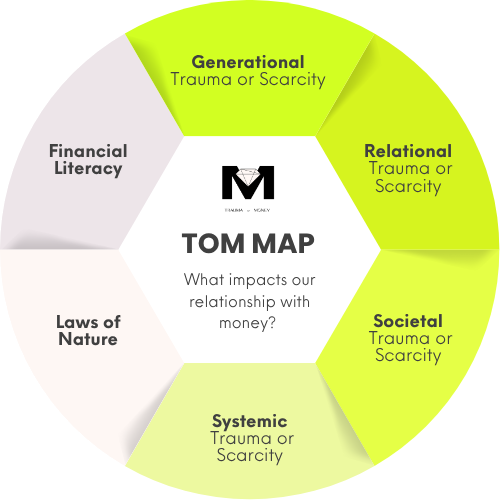
A six-layer model of what shapes our relationship with money.
Beyond “financial trauma” — the TOM Map situates each person inside the layers of generational, relational, societal, and systemic experience that influence financial behaviour, alongside the laws of nature and financial literacy.
A global destination at the intersection of entrepreneurship, mental health, wealth advising, and economic justice.
Our programs support practitioners in developing the attunement, discernment, and relational capacity needed to work with money and power in ethical, human-centred, and context-aware ways across diverse professional and cultural settings.
Integrating safe, attuned concepts into financial and leadership support.
A four-step approach used across our certifications — practical, compassionate, and grounded in nervous-system literacy.
Identify & Name Behaviours
Notice and name patterns — avoidance, perfectionism, scarcity-based decision-making — and approach each with compassion so individuals feel seen and understood.
Regulate Your Own Nervous System
Recognize your own stress triggers in a support role. Use grounding practices to stay calm and centred — preventing burnout and the projection of urgency or anxiety.
Attunement & Language Adjustments
Make small but powerful shifts in communication to affirm and resource the person in front of you — reframing challenges as opportunities for growth and resilience.
Distinguish Scarcity Mindset & Real Resource Gaps
Discern whether a challenge stems from mindset or an actual lack of resources. Address urgent needs first, then co-create strategies for long-term sustainability.
Trusted by finance, philanthropy, post-secondary, and community institutions.






















The Trauma of Money challenges the myth that financial struggles are personal failings. Chantel Chapman, with insights from leading experts, offers a powerful path to healing and reclaiming financial agency.

Chantel absolutely blew our audience away — we have received such wonderful feedback so far.
I recommend Trauma of Money to everybody. What it did for me was marry the neuroscience of trauma with my mental-health training in a way that made everything click in such a profound way.

World-class educators. Real-world expertise.
Faculty are selected based on expertise and alignment with each program’s goals. Assignments are subject to availability and confirmed in collaboration with your team.







Let’s shape something specific to your community.
Every engagement begins with a discovery conversation. Tell us about your organization, your people, and what you’re trying to make possible — and we’ll come back with a tailored proposal.
Custom pricing · Discovery and design calls included · Licensing agreement provided.